
Image credit: Evan Stout
Exploring Wolf Communication Through AI
Wolves are highly social animals that rely on vocal communication to maintain contact, coordinate activities, and interact with their pack. Their howls can travel up to 16 kilometers in open areas, but there is still much we don’t understand about the information they carry. Can individual wolves be identified by their voices? What might their calls reveal about their social relationships and behavior?
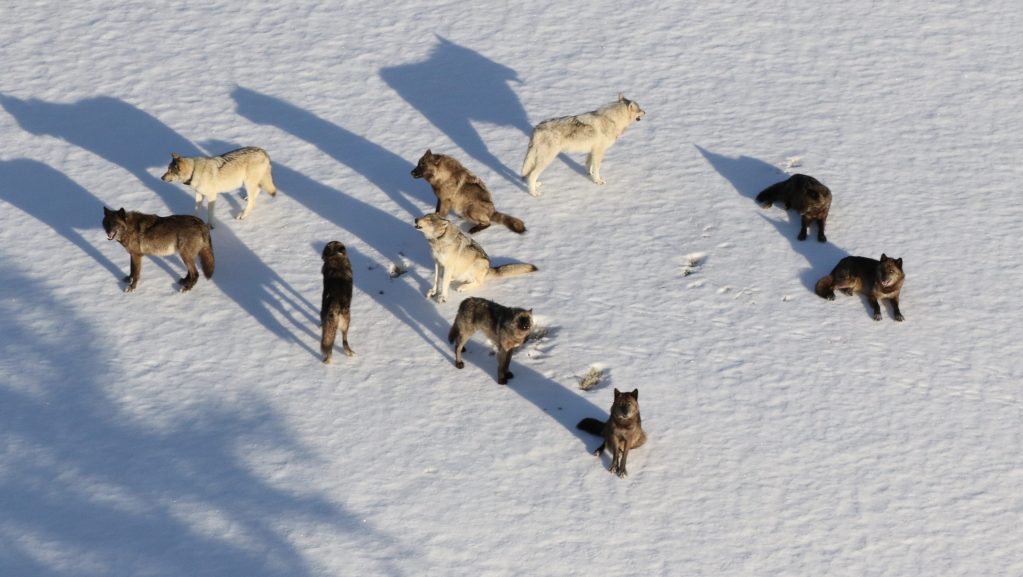
Dr. Jeffrey Reed, co-founder of The Cry Wolf Project, and Jeremy SunderRaj, a PhD candidate at the University of Montana, are investigating these questions in the Greater Yellowstone Ecosystem. Their research builds on decades of detailed records collected by the Yellowstone Wolf Project, alongside acoustic recordings gathered across the region. The recorders collect around half a million hours of audio each year, providing a wealth of data for researchers to study. However, analyzing these recordings manually would be an enormous undertaking.
To help address this challenge, Jeff and Jeremy are using GrizCam Desktop, an audio analysis application developed by Jeff’s company, Grizzly Systems, which uses AI models from Earth Species Project and Google DeepMind to detect and classify wolf vocalizations across thousands of hours of recordings.
In this Community Spotlight, we speak with Jeff about what inspired The Cry Wolf Project, how AI is helping his team identify and analyze wolf vocalizations, and how a better understanding of wolf vocalizations could help inform conservation efforts and improve how we coexist with wolves.
What inspired The Cry Wolf Project, and what are you ultimately hoping to understand about wolf communication?
Yellowstone is one of the few places on Earth where you can put a microphone in the woods and already know, for many of the wolves you record, who their parents were, which pack they belong to, how old they are, and often how they died. The Yellowstone Wolf Project has kept detailed records since 1995. While many bioacoustic datasets lack this kind of background information, Yellowstone offers a unique opportunity to connect decades of knowledge about individual wolves with large-scale recordings of their vocalizations.
Recorder-hours annotated to date — 28.4 recorder-years
Recordings, averaging 59.9 minutes each
Sites · 532 deployments
Human annotations and climbing
Wolf sound types labeled, of more than twenty known
Hours of sound now recorded per year
What we ultimately want to know is whether a howl carries a who and a why. We already label the what. Now we want to understand who is calling and what prompted them to do so. If individual wolves have stable acoustic signatures, we could estimate population size simply by listening to their howls, monitor changes in a pack's social structure across a season, and investigate whether particular call types serve particular functions.
Our interest in wolf communication also extends to dogs. Dogs descended from an ancestral wolf population through a process of domestication that began somewhere between fifteen and forty thousand years ago. We're interested in how their communication has changed over that time, and what wolves and dogs might still have in common.
Walk us through The Cry Wolf Project dataset – how it’s collected across the Greater Yellowstone Ecosystem, and what makes it different from the audio most bioacoustic models are trained on?
We place a microphone in one of two places - on a tree or on a wolf. Recorders placed on trees capture what's known as far-field audio, or sounds recorded from a distance. Across 63 sites, we've collected nearly 250,000 hour-long recordings from 532 deployments.
Microphones attached to wolves capture near-field audio, recording their vocalizations much closer to the source. We currently have biologgers deployed on more than 15 wolves, and have recovered recordings from two yearling females. Together, they've provided 816 hours of audio.
A recorder on a tree can tell us when a wolf calls nearby, but a microphone on a wolf records throughout the day, including when the animal is silent. That lets us measure how much time an individual spends vocalizing. So far, the wolves have spent around 2% of their day calling, roughly half an hour every 24 hours.
We are now testing CollarID, solar-powered biologgers designed to record for years rather than weeks. Longer recordings could help us investigate questions that short-term studies simply cannot. For instance, do different packs have distinct vocal patterns? Do pups learn calls from adults? Does a wolf's voice change as it ages?
How have foundation models changed your approach to detecting and classifying wolf vocalizations compared with the methods you were using previously?
They changed what a few thousand labels are worth. Language models can be trained on trillions of words, but we have nowhere near that amount of labeled data for animal sounds. Collecting and annotating recordings takes considerable time and fieldwork, which is why our 9,847 labeled howls represent a substantial dataset for wolf research, even though it's tiny compared with the datasets used to train language models. This shortage of labeled recordings is one of the biggest challenges in animal communication research.
Foundation models help us overcome some of that challenge. When you train a model from scratch using a few thousand howls, it first has to learn general patterns in sound before it can recognize anything specific to wolves. A foundation model has already learned many of those patterns from large amounts of audio, so we can use our limited labeled recordings to train it to recognize the sounds we're interested in.
Two things made a significant difference in our work:
- Real-world training examples: We added negative examples, meaning recordings without the target sound, drawn from the same field conditions in which the detector would operate. This reduced false detections by about fourteenfold.
- Foundation model distillation: We then used a foundation model to help train our smaller detector, roughly doubling the proportion of target sounds it could identify without increasing false detections. This only worked after we'd added the real-world training examples.
The foundation model improved the detector's performance, but the right training data was essential to making it work in the field.
You compared several AI models, including Earth Species Project's models. What did you find, and how has that influenced your approach?
We compared three of Earth Species Project's AVES2 audio encoders, including one derived from NatureLM-audio, alongside Google DeepMind's Perch 2.0. ESP's BEATs-based encoders performed best overall, with the NatureLM-audio-derived encoder achieving the highest score for detecting wolf choruses and tying with SL-BEATs for individual howls.
Across all the models we tested, detecting a chorus of wolves howling together was easier than detecting individual howls. ESP's EfficientNet-B0 encoder was slightly less accurate, but was faster to train and required considerably less computing power, making it a useful option when resources are limited.
| Foundation model | Type | Howl F1 | Chorus F1 | Train time |
|---|---|---|---|---|
| ESP-AVES2 NatureLM-audioesp_aves2_naturelm_audio_v1_beats | BEATs transformer, ~90M | 0.903 | 0.981 | 30–40 min |
| ESP-AVES2 SL-BEATsesp_aves2_sl_beats_all | BEATs transformer, ~90M | 0.903 | 0.979 | 30–37 min |
| Perch 2.0Google DeepMind | CNN, 5 s window | 0.887 | 0.954 | 93–125 min |
| ESP-AVES2 EfficientNet-B0esp_aves2_effnetb0_all | CNN, ~5M | 0.864 | 0.962 | 22–25 min |
Table 1: Model performance on wolf vocalization detection.
As a result, we now use ESP's NatureLM-audio-derived encoder as our main wolf detector. We use EfficientNet-B0 when working with less powerful equipment or experimenting with new types of sounds, where speed is more important. We also use Perch when working across different species because it has been trained on a broad range of animal sounds.
A big part of the challenge seems to be telling wolves apart from coyotes, wind, aircraft, and other soundalikes in the field. How do Earth Species' embeddings help the classifier hold up against those confounders?
ESP's audio models have already learned to recognize general patterns in animal sounds, helping our classifier distinguish wolf vocalizations from background noise such as wind and aircraft. Coyotes are harder. They're closely related to wolves, and their calls can overlap in pitch and other acoustic characteristics. While the models help us distinguish between the two species, we also need recordings of coyote calls that have been identified and labeled by researchers. We've made 1,159 coyote annotations specifically to help train the classifier, although coyote vocalizations still account for most of the sounds it incorrectly identifies as wolves.
Getting that distinction right matters for conservation, too. Mexican gray wolves and red wolves are among North America's most endangered canids, and both are difficult to monitor in the wild. Acoustic surveys could eventually help researchers detect these animals across large areas without needing to observe them directly.
One possibility we're interested in exploring is whether differences in vocal tract length and resonance produce distinctive acoustic patterns that could help distinguish Mexican gray wolves from red wolves, even when their calls overlap in pitch. We've already measured some of these acoustic characteristics in our wolf recordings, but haven't yet tested whether they can reliably distinguish these two types of wolves. That's something we'd like to investigate next, ideally with partners who have recordings of both.
What are you learning about wolf communication that you wouldn't have been able to investigate without these new tools?
We can now measure how much of a wolf's day is spent calling. Individual howls are brief, lasting a median of about six seconds, but wolves also produce longer sequences of calls and howl together in choruses.
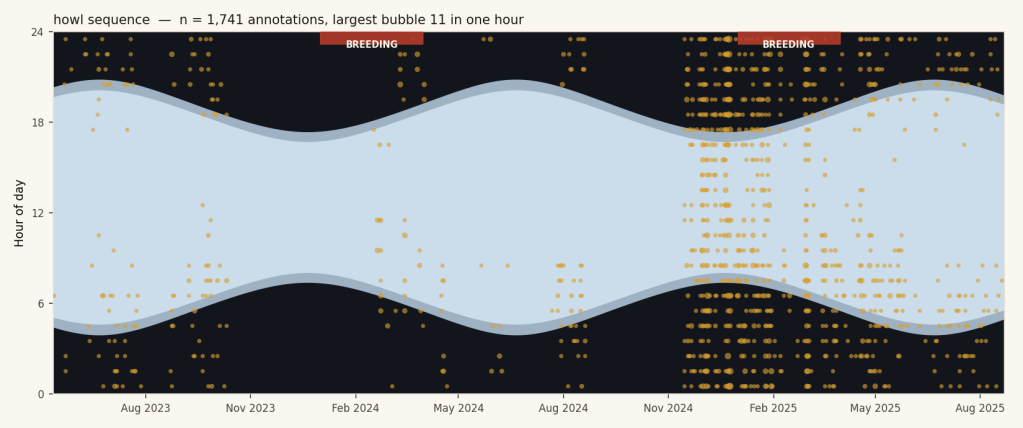
We're learning more about when wolves vocalize. For example, our recordings show that around 60.5% of howl sequences and 68% of choruses occurred at night, calculated using the position of the sun rather than clock time.
We're also investigating how the sounds themselves vary. Using a generative AI model called fiwGAN, previously applied to sperm whale communication, we've identified 13 acoustic features that can be independently adjusted in artificially generated wolf howls. Three of these features can also be identified in noisier recordings collected in the field. It's still early, but understanding how howls differ in their acoustic structure could eventually help us investigate what those differences might mean.
What are you learning about wolf communication that you wouldn't have been able to investigate without these new tools?
One of our main goals is to develop species-agnostic tools that can be used to study a wide range of animals. Our recorders capture sounds from across the Greater Yellowstone Ecosystem, and we're now collecting around half a million hours of audio each year. That data could support research into many different species beyond wolves. GrizCam Desktop is designed to make that possible, allowing researchers to train detectors for different species using their own labeled recordings. We're also using the same software to train gunshot detectors, which could help with wildlife crime monitoring.
Many wildlife researchers face the same challenge: they have far more recordings than they can listen to, limited labeled data to train models, and often lack access to powerful computing resources. Conservation teams are frequently underfunded and understaffed, so making these tools easier and more affordable to use could make a real difference.
We've already built an extensive dataset in one of North America's most biodiverse temperate ecosystems. Now we're expanding our work to other species, including elk, bison, grizzly bears, cougars, and great gray owls. We're using AI models that can learn from just a few labeled examples to help identify their sounds in recordings we've already collected. And thankfully, this time I won't have to sit and review more than 200,000 hour-long recordings on my own!
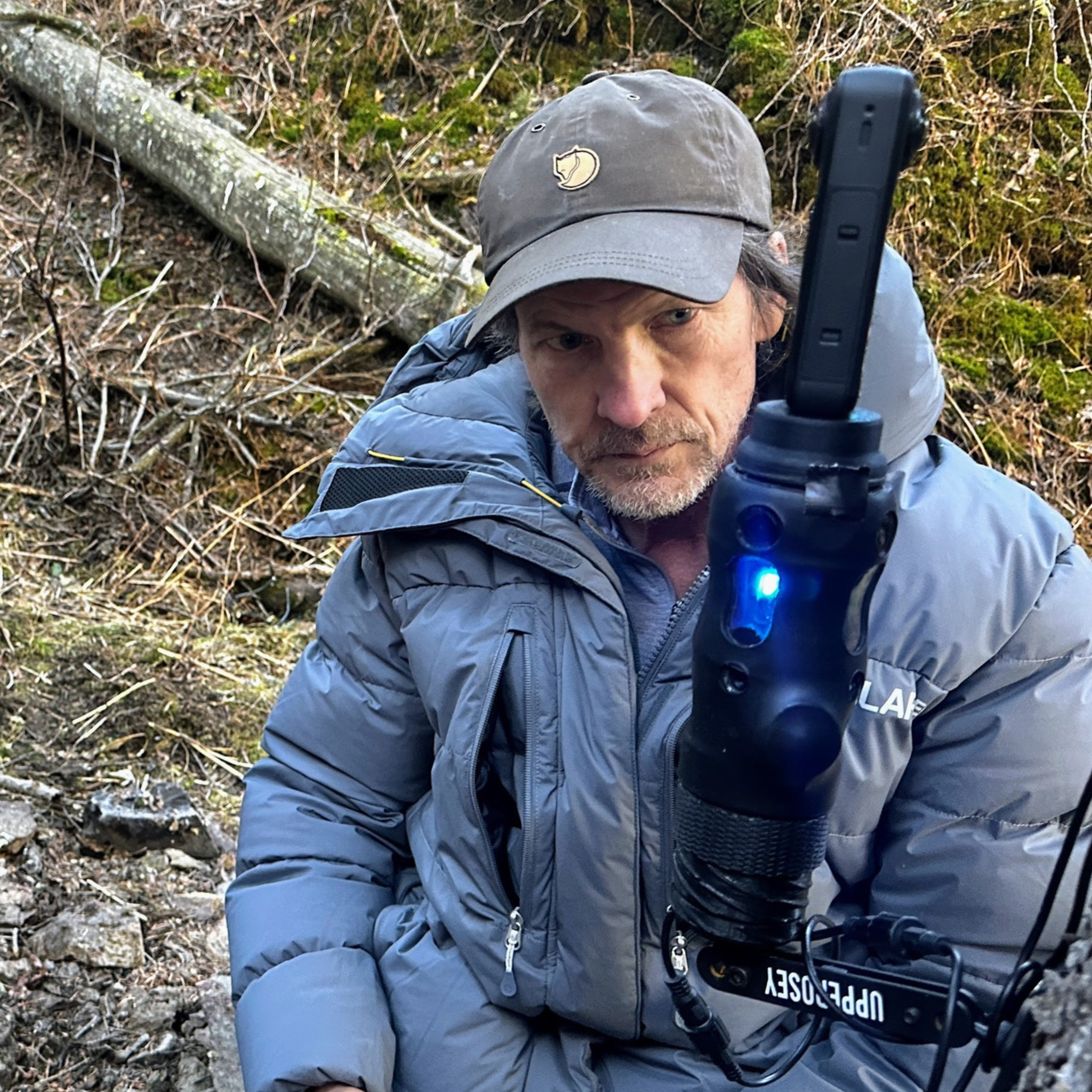
Dr. Jeffrey Reed lives his life as a feral linguist, inventing conservation tech in the mountains of Montana. With a doctorate in computational linguistics focused on decoding ancient languages, Reed spent three decades in the world of Silicon Valley building machines that replicate human language before turning his attention to the living voices of the wild—from wolf howls to elk bugles. He co-founded The Cry Wolf Project, the world’s largest database of wild wolf vocalizations, and founded Grizzly Systems, pioneers of low-cost technology for wildlife research and remote security monitoring. A lifelong outdoorsman and conservation advocate, Reed co-founded the Wild Livelihoods Business Coalition, a collaborative effort to protect Montana’s last wild places while sustaining its local economies.
His forthcoming book, Howl: The Secret Language of Wolves (Little, Brown) explores the science—and soul—of wolf communication. He lives with his amazing pack—his wife, Robin, and three talkative dogs—Ozzie, Huck and Shiloh—on their farm in southwest Montana. His work has been featured by HBO, TED, Nvidia, PBS News Hour, NPR, Washington Post, Inc Magazine, Animal Planet, SFGate, Montana Outlaw, Colossal Biosciences (of dire wolf fame), Smithsonian National Museum of Natural History and others.
CONTACT: Jeff T Reed PhD - jeff@grizzlysystems.io | www.thecrywolfproject.com | www.grizcam.com/grizears
Disclaimer: Our Community Spotlight series highlights research and perspectives from across the animal communication community. Featuring this work does not imply endorsement by Earth Species Project, but reflects our commitment to sharing emerging research and advancements across the field.