

Image credit: Bejan Adrian / Pexels
Key Takeaways
- BirdCODE is a supervised deep learning model that offers zero-shot sound event detection, enabling researchers to detect and classify bird vocalizations with temporal precision and without dataset-specific fine-tuning.
- The model was developed using a combination of training strategies using weakly labelled recordings, synthetic soundscapes, and pseudo-labelled data to perform sound event detection and classification across more than 9,000 bird species.
- Applying BirdCODE to more than one million recordings demonstrates how large-scale temporal annotation can enable new analyses of vocal behaviour across species, seasons, geography, and mixed-species interactions.
- BirdCODE, the model weights, and large-scale detections are openly available on GitHub to support future research in Animal Language Processing.
- This paper is a preprint and currently under review.
Sound Event Detection: A Bottleneck in Bioacoustics
Sound event detection remains one of the central challenges in bioacoustics. While recent machine learning models have dramatically improved species classification, detecting the precise temporal boundaries of individual vocalizations remains difficult, particularly at large taxonomic scales where strongly labelled training data are scarce.
For researchers interested in animal communication, this limitation is significant. Studying communication at scale depends on accurate temporal annotation. Understanding interactions between individuals often requires knowing precisely when each vocalization begins and ends relative to every other vocalization. Solving this challenge is therefore a prerequisite for studying animal communication at scale.
Introducing BirdCODE
To address this challenge, we developed BirdCODE (Bird Communication Detector), a deep learning model for large-scale sound event detection and classification across more than 9,000 bird species.
Unlike conventional sound event detection systems, BirdCODE does not rely on extensive strongly labelled training datasets. Instead, it learns from the vast collection of weakly labelled recordings contributed through citizen-science initiatives, combining them with synthetic soundscapes and pseudo-labelled predictions in a multi-stage training pipeline.

BirdCODE achieves state-of-the-art performance on both sound event detection and species classification benchmarks, extending sound event detection to roughly 100 times more bird species than previous bioacoustics-focused systems.
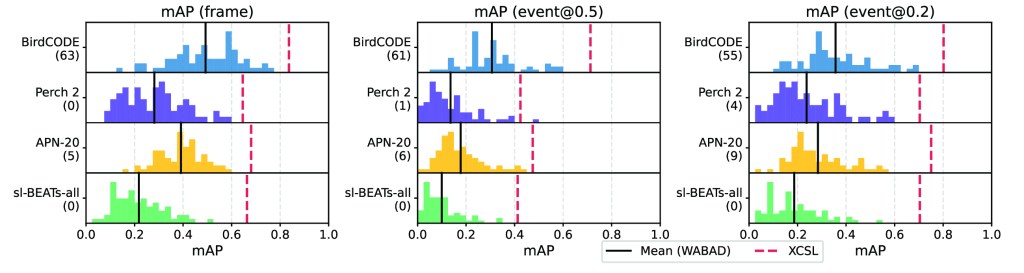
BirdCODE demonstrates that large-scale, zero-shot sound event detection is possible, even when strongly labelled datasets are unavailable. While strong benchmark performance is valuable, it is not the end goal. The real measure of a sound event detection system is whether it accelerates existing science and enables new discoveries.
From Detection to Discovery
To demonstrate that potential, we applied BirdCODE to more than one million community-contributed recordings and used the resulting detections to investigate several biological questions. Anyone can load these detections on publicly licensed data from xeno-canto and iNaturalist within alp-data by following the instructions on the GitHub repo.
What We Found
Phylogenetic Patterns in Vocal Behaviour
Birds that are closely related often share similar traits in their vocalizations, a pattern shaped by their shared evolutionary history. Studying this connection has traditionally required extensive human annotation of individual vocalizations. Using BirdCODE detections instead, we examined whether vocalization duration tracked the avian phylogeny, drawing on recordings across a wide range of species and controlling for factors like body size, beak length, and habitat that might otherwise explain similarities between species.
Using BirdCODE detections, we found similarities in vocalization duration among closely related species across the avian phylogeny. This result complements prior research into how a bird’s evolutionary history influences its vocal behavior, and shows how BirdCODE can support new research in comparative bioacoustics.

Seasonal Variation in Vocal Behaviour


Applying BirdCODE across year-round recordings of two common European songbirds, the great tit (Parus major) and the European robin (Erithacus rubecula) revealed seasonal shifts in vocal behaviour within species, including changes in call duration and acoustic characteristics in species such as the great tit and European robin. These matched known phenological patterns in these common songbirds, demonstrating BirdCODE’s ability to detect and quantify season variations at scale, without the intensive manual annotation that this kind of analysis typically requires.

confidence interval.
Geographic Variation in Vocalizations

Credit: Charles J. Sharp / CC BY-SA 4.0
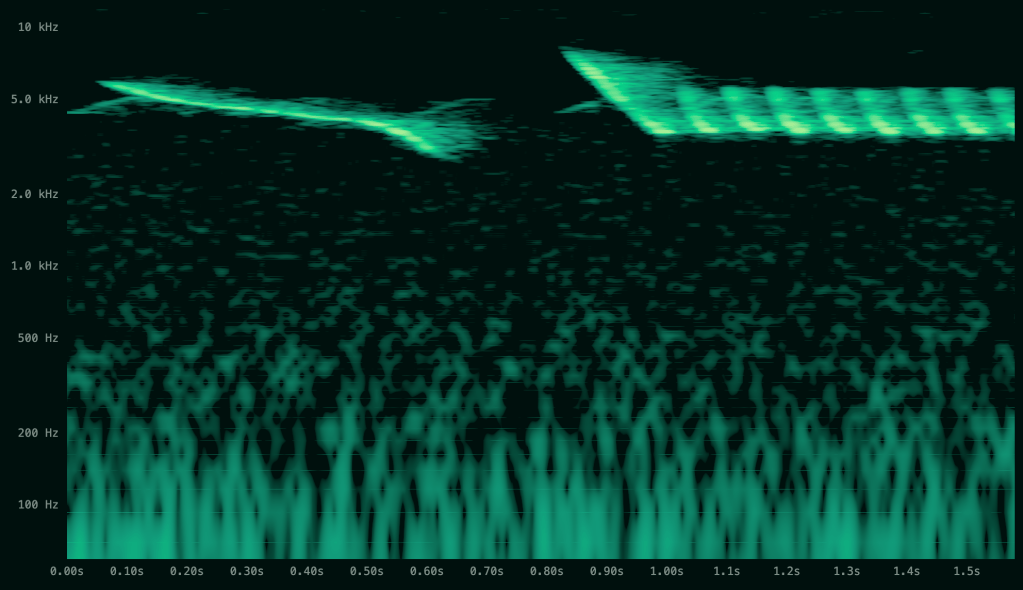
Analyses of BirdCODE detections also captured geographic differences in the songs of rufous-collared sparrows (Zonotrichia capensis), a small songbird widespread across South America. Their songs sometimes end in a trill or buzz, a feature used by some populations but not others, possibly linked to differences in habitat.
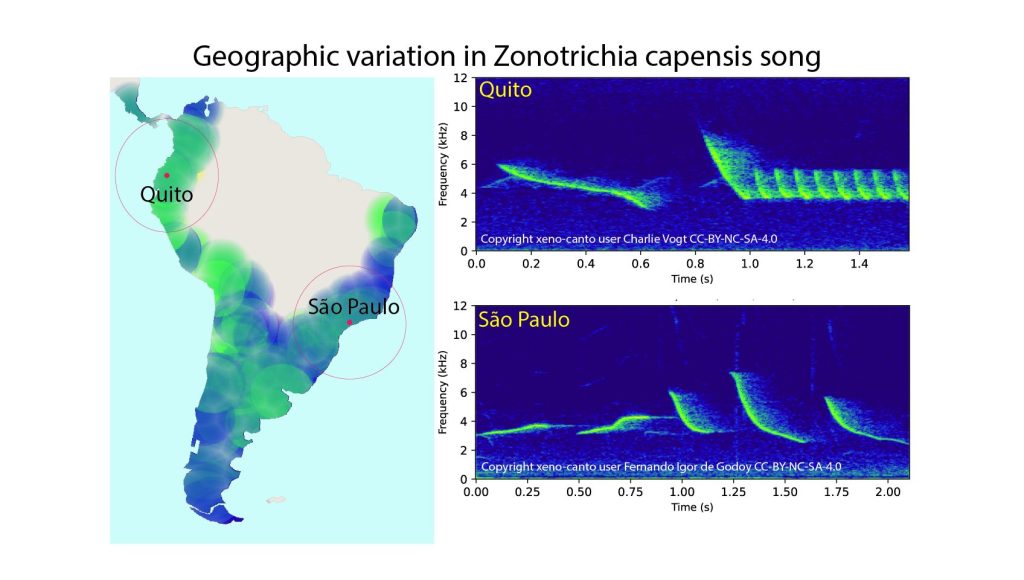
Mapping the average spectral entropy of these songs across a 500-km radius, we identified two well-sampled regions with contrasting patterns: around Quito, Ecuador, and around São Paulo, Brazil. Songs near Quito showed higher average spectral entropy, while those near São Paulo showed lower entropy.

Credit: Fernando Igor de Godoy / CC BY-NC-SA 4.0
Credit: Charlie Vogt / CC BY-NC-SA 4.0
Since trills tend to sound noisier than non-trilled songs, we predicted that the higher-entropy region would contain more trills. A manual check of the recordings confirmed this: sparrows recorded near Quito often included a trill in their song, whereas none of the sparrows recorded near São Paulo did.
This demonstrates how large-scale sound event detection can support the study of geographic variation in vocal behaviour, including identifying region-specific dialects.

Cross-Species Vocal Interactions
In North American winters, chickadees, white breasted nuthatches, downy woodpeckers, and tufted titmice congregate into foraging flocks. Applying BirdCODE to recordings of these flocks, we looked at whether a vocalization from one species predicted a vocalization from another within the following five seconds, then compared that to what would be expected by chance.

This revealed that chickadees respond to nuthatches and titmice more readily than expected by chance, and that white-breasted nuthatches respond similarly to downy woodpeckers.
These results offer a scalable framework for investigating cross species interactions and coordination in natural soundscapes.
Building Infrastructure for the Future of Bioacoustics
At ESP, we build AI tools that help scientists overcome technical barriers and accelerate discovery. BirdCODE is one example of that approach. By releasing the model, code, and large-scale detections, we hope to provide infrastructure that researchers can build on in ways we can’t yet predict.