
Image credit: Deborah / Adobe Stock
Key Takeaways
- alp-data is a pip-installable Python package that provides unified access to 35+ bioacoustic datasets through one consistent interface.
- This removes the per-dataset engineering work that often stands between researchers and the large, diverse training corpora required to study animal communication at scale.
- alp-data is the first piece of shared infrastructure for Animal Language Processing (ALP), an approach to studying animal communication that is AI-powered, data-driven, and species agnostic.
- We are also introducing the ALP Data Explorer , a visual tool to help anyone explore a subset of the cross-taxa data contained in alp-data.
- Important note: We compiled and unified these datasets. We did not create them. Each one remains governed by the license its original creators set.
- alp-data is free and hosted by ESP.
Turning Fragmented Data into Shared Infrastructure
The study of animal communication is moving toward large-scale, AI-driven inquiries across populations, species, and taxa. We introduced the term Animal Language Processing (ALP) as a name for this emerging field of study that aims to answer questions like: How do animal dialects emerge across populations or geographies? How does communication change across populations with unique dialects?
That shift – towards a data-driven, AI-powered, and species-agnostic approach – requires far more data infrastructure than the field currently has. While there’s been an explosion in bioacoustic and other ecological data, much of it remains out of reach for training and evaluating large AI models.
Today, we’re introducing alp-data, the data access layer we use within our own organization, and one of the first pieces of Animal Language Processing infrastructure.


Figure 1: Taxonomic diversity represented within the alp-data collection. These sunburst charts illustrate the breadth of mammalian (left) and avian (right) taxa currently included, with each ring representing progressively finer taxonomic levels from class to order and family.
As we trained and evaluated our models across increasingly diverse datasets, we found ourselves repeatedly solving the same data-access problems. Over time, those internal tools evolved into a unified access layer that became part of our own research workflow. Today, we’ve open-sourced it so that the wider field can work from the same foundation.
The Animal Language Processing Bottleneck
The abundance of bioacoustic data is, by now, well established. Passive acoustic monitoring, animal-borne tags, and sustained recording efforts have produced data across species and environments at a scale that would have been difficult to imagine a decade ago.
Now, the challenge is in turning that data abundance into models capable of meaningful generalization.
Models generalize when they can perform well on data they have never seen before. In animal communication research, that means transferring what they have learned across species, taxa, and recording conditions. Achieving that kind of generalization requires training on diverse data at breadth and scale.
“The biggest lesson that can be read from 70 years of AI research is that general methods that leverage computation are ultimately the most effective, and by a large margin.”
– Rich Sutton, The Bitter Lesson
Our own work on bioacoustic encoding pointed in this direction: models like NatureLM-audio that are exposed to a wide diversity of training data, including general audio alongside bioacoustic recordings, generalize more reliably across tasks and species than smaller, domain-specific models.
Yet building models that generalize across species requires substantial data engineering before any machine learning begins.
Imagine you’ve identified five datasets that could help answer your research question. The problem? They are hosted on multiple platforms. BirdSet uses one schema, Xeno-Canto another, Watkins yet another. Each comes with its own sampling rates, file structures, metadata conventions, and licensing terms. Before you’ve trained a single model or run a single experiment, you find yourself spending days or even weeks making these datasets work together.
Combining even a handful into a single training set requires writing and maintaining a bespoke data loader, alongside paying for storage, testing for consistency, tracking lineage and provenance, and allowing dataset schemas to evolve while maintaining backwards compatibility across versions.
Every additional taxon (let alone other modalities like video or behavioral notes) enlarges the surface area of formats to be handled, so that the corpora most valuable for cross-taxa work – the broadest and most diverse – are also the most difficult to construct.
What alp-data Is
alp-data is a standardized point of access to bioacoustic datasets. It is a Python package installed with a single command (pip install alp-data) that provides access to 35+ bioacoustic datasets through one interface. Whatever a dataset’s original format or location, it is loaded, streamed, and combined in the same manner as every other dataset in the collection.
Each dataset behaves as a standard Python object that can be iterated over, indexed into, or streamed sample by sample when it exceeds available memory.
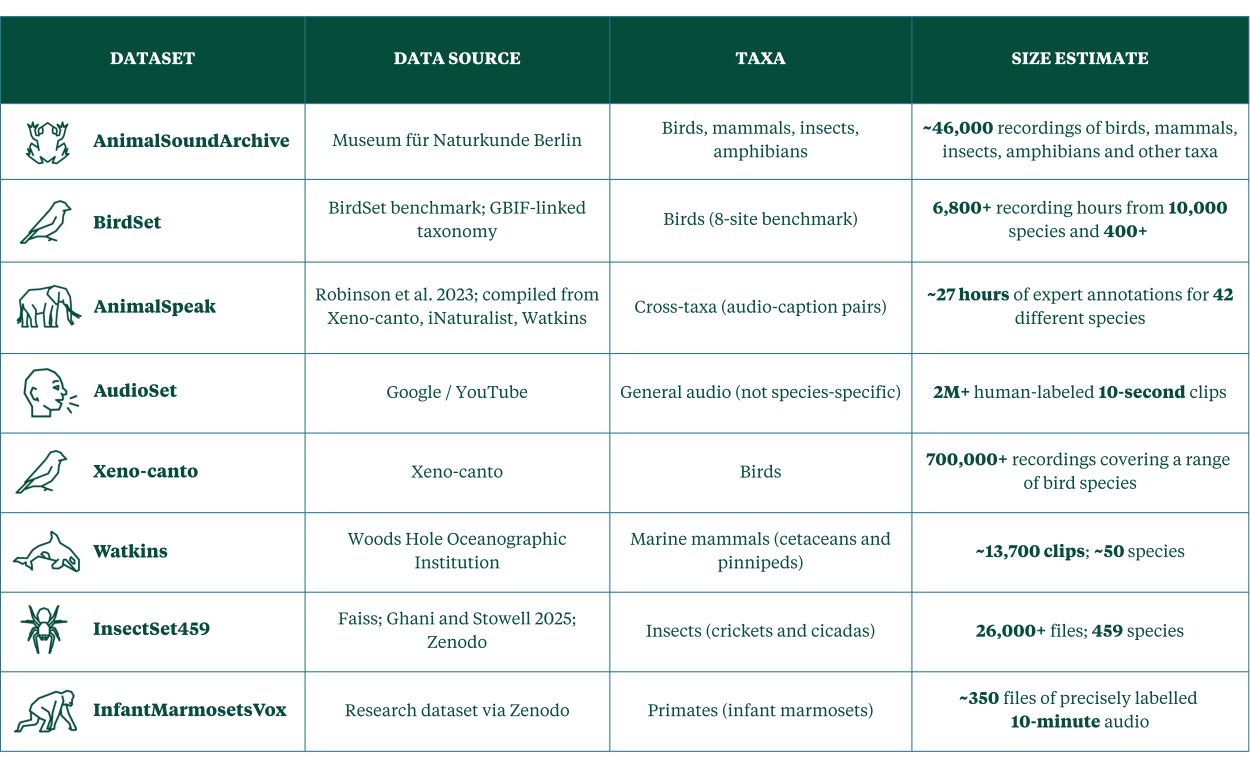
Every sample returns its audio and sample rate in a consistent form, with dataset-specific labels and annotations carried alongside. The operations that normally precede training, including sampling-rate harmonization, label derivation, and split-aware loading, are handled within the interface itself. Datasets can be filtered, reshaped, and concatenated or chained into a single combined dataset for training or evaluation, which means that assembling a broad multi-taxon corpus becomes a matter of composition rather than of writing and maintaining a new pipeline for each source. Datasets can be declared, combined, or transformed all from a YAML config file allowing for reproducibility in training and evaluation runs.
We use alp-data extensively to drive several recent publications and in our open source packages like AVEX.
“Organizing and preprocessing data used to be one of the most time consuming parts of my research. With alp-data, that’s largely automated, freeing up more time for the part I love most, digging into the results.”
– Sara Keen, ESP Senior Research Scientist
ALP Data Explorer
Alongside alp-data, we’re also introducing the ALP Data Explorer, giving anyone a simple way to explore a curated selection of the bioacoustic datasets available, directly in your browser. You can browse recordings across species and taxa, explore where they were collected, and listen to audio samples without writing a line of Python.
While the Explorer showcases only a subset of the available collections, it provides an approachable introduction to the datasets behind alp-data.
As alp-data continues to evolve, we hope tools like the explorer can make it easier to discover datasets, compare collections, and navigate the growing landscape of animal communication data.
Data Ownership and Licensing
alp-data provides access to datasets, but Earth Species Project doesn’t own any of the datasets, nor did we create them. We compiled and unified access to work that belongs to the researchers and institutions who recorded, annotated, and published them. The majority of these datasets are openly licensed, though terms vary, and each retains the license its creators assigned. License and source metadata travel with the data and remain available per dataset, because provenance is as much a part of responsible infrastructure as access is.
You can find more about the datasets included in alp-data here.
Data Contributions
Researchers with bioacoustic datasets interested in making them more accessible, are warmly invited to get in touch. We are reviewing data contributions on a case-by-case basis as the collection grows and we would love to hear from you!
We offered Animal Language Processing as a provisional definition, meant to be sharpened and refined through use. alp-data is offered in the same spirit, as a first piece of shared infrastructure that the field can build on together.
alp-data Limitations
Current limitations of alp-data include:
- alp-data covers bioacoustics alone.
- Its coverage leans toward birds, a reflection of where openly licensed data is most plentiful.
- Licensing and credit constrain access to a subset of datasets, which appear named and credited even in cases where the underlying audio cannot be retrieved through the interface.
- The package assumes a working familiarity with Python and machine learning, and so it is not yet suited to researchers without a computational background.
Getting Started
The package can be installed directly:
pip install alp-data
We’ve created seven tutorial notebooks to help you get started. They cover the library’s core features, such as loading your first dataset, working with PyTorch DataLoaders, and combining datasets for training and evaluation. Documentation, tutorials, and the full dataset listing are available on the project page, and the source is on GitHub. To submit feedback or join the discussion on alp-data, visit our forum on Discourse.
Coming Soon
- More datasets, including Passive Acoustic Monitoring (example: direct-from-bucket streaming).
- Enhanced performance and scalability through more advanced backend technologies and data management tools.
- Strengthened dataset organization to improve reproducibility and benchmarking across studies.
- Expand beyond bioacoustics to support other modalities relevant to animal communication, including video, behavioral data, movement data, and field observations.
- Develop the platform in collaboration with the broader research community, guided by real-world research needs and feedback.