
Image credit: Quang / Adobe Stock
Individual ID in Chatty Species
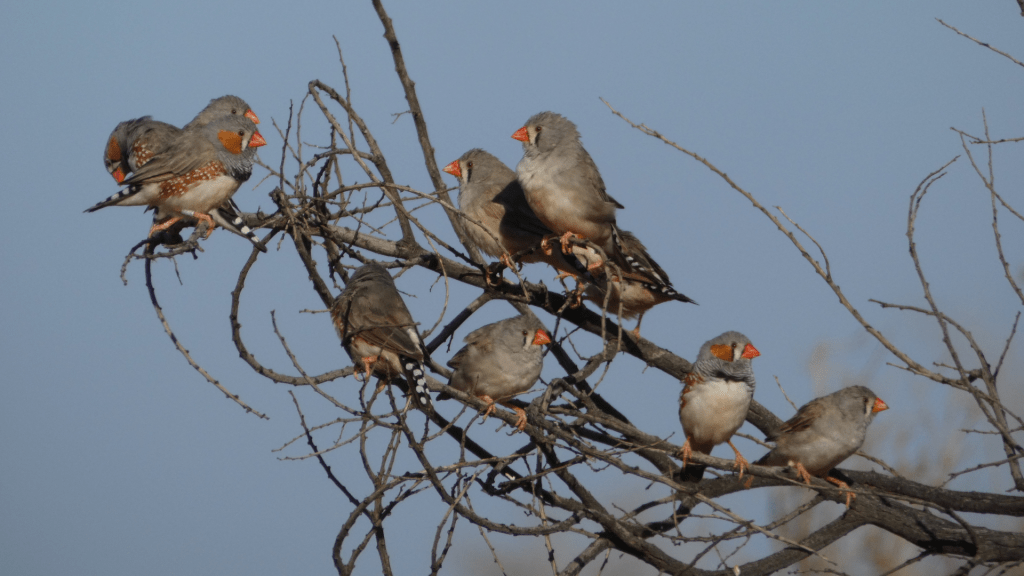
In the wild, zebra finches don’t sing in isolation. They move through dynamic social groups, calling and responding to one another across space and time. For ecologists, understanding this communication requires knowing who is communicating with whom, and how information flows through a group.
Tracking communication at the level of individuals, however, has long been out of reach, especially in highly social, “chatty” animals that operate in large groups. In natural soundscapes, following specific birds across time requires painstaking manual annotation, and even then, it’s difficult to scale beyond small datasets or controlled settings.
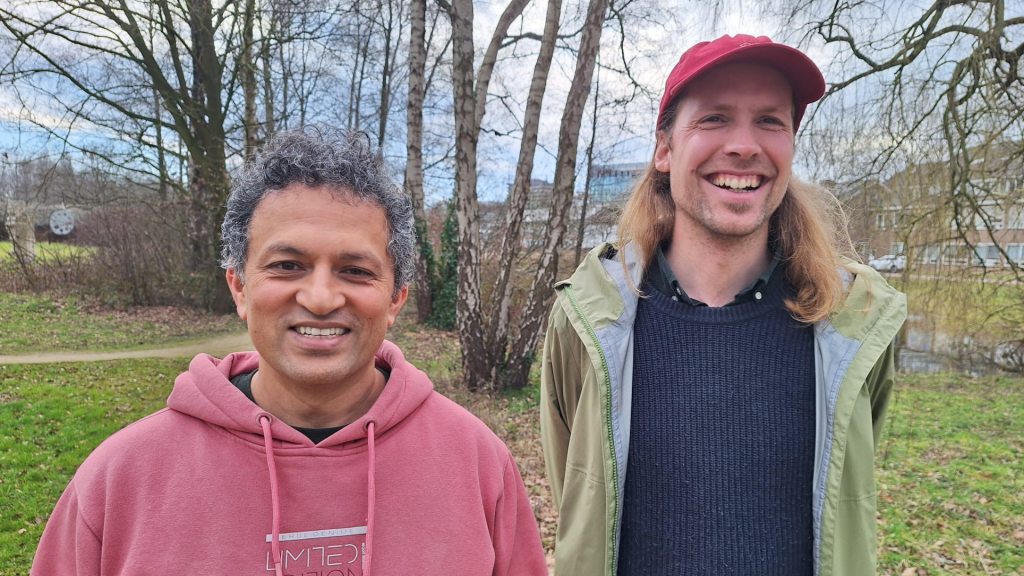
This challenge brought together two different perspectives. Dr. Hugo Loning, an ecologist studying wild zebra finches, and Dr. Aneesh Chauhan, an AI and robotics researcher exploring bioacoustic monitoring. Together, they began exploring how AI can help identify individual birds in the wild.
To do this, they applied BirdAVES, a self-supervised bioacoustic model developed by Earth Species Project. This approach aims to make it possible to recognize individual zebra finches from field recordings, turning hours of audio into “who-sang-when” timelines and enabling new questions about social behavior, movement, and information sharing. Their paper was accepted at the first AI for Non-Human Animals Workshop at NeurIPS 2025.
We spoke with Hugo and Aneesh about how the collaboration came together, what it takes to study communication in the wild, and how tools like BirdAVES are helping bridge the gap between ecology and AI.
⮕ How did this collaboration between ecology and machine learning come together in the first place?
[Hugo] I first met Aneesh after attending one of his talks on a collaborative project on local biodiversity monitoring with colleagues in my group. For that project, Aneesh had used classical bioacoustic monitoring methods and BirdNet to identify which species were present and to measure broad biodiversity metrics in a local organic community-run garden and in a University farm in Brazil, and was now wondering whether his results made sense. I approached Aneesh after the talk thinking I could potentially help validate his results as I am a reasonably knowledgeable birder in our region. At that point, we were working on zebra finch acoustics in the wild. We were labeling their songs at the individual-level by hand, but I was already wondering if there would be any opportunities to make that work more efficient with the help of machine learning methods.
[Aneesh] I was exploring the use of bioacoustic technologies to monitor bird biodiversity near ecological farms in Brazil and the Netherlands, in collaboration with an ecologist colleague of Hugo’s. The results had been quite interesting and we presented our work in a seminar where Hugo was present. Later, we followed-up from there. Amongst other topics, we discussed the zebra finches, and the seed of collaboration was planted.
In a previous life (during my PhD) I worked on language-grounding in robots through communication between humans and robots. In that work, the literature would refer to zebra finches as a model species, where the evolution of communication has been very widely studied. To have the opportunity to actually work on zebra finch communication… now that was exciting.
⮕ From an ecologist’s standpoint, what are the biggest limitations of traditional approaches to studying animal communication in natural soundscapes?
[Hugo] As an ecologist, it is very valuable to have information about the individual, because natural selection mostly takes place at the individual level. When working with free-living animals in the natural environment, there are big limitations around being able to follow the communication between known individuals across space and time. To overcome this limitation, traditionally, a lot of biological work has been done on animals that communicate at a fixed time and place, such as territorial songbirds singing at dawn. With our new approach, we can now start exploring the communication networks of non-territorial species with a very dynamic and active social life such as the zebra finch.
⮕ What made you choose to use BirdAVES?
“The supervised approaches, like BirdNet, are designed to a fixed set of species for which labelled data is necessary. BirdAVES, on the other hand, is a self-supervised model that learns without annotations and can transfer better to new scenarios.”
[Aneesh] BirdAVES was not the only choice for us. There are multiple approaches that leverage bioacoustic data, especially of bird species identification, such as BirdNet or Perch. But none of these methods specialize in identifying individuals within the species. And when communication is between individuals, species-level identification is too broad – it is necessary to identify individuals in order to disambiguate who is singing.
The supervised approaches, like BirdNet, are designed for a fixed set of species for which labelled data is necessary. BirdAVES, on the other hand, is a self-supervised model that learns without annotations and can transfer better to new scenarios. Individual detection is a very unique scenario, and we hypothesize that the self-supervised approach could scale better to our scenario of individual zebra finch identification.
⮕ What was it like to incorporate BirdAVES into your research workflow?
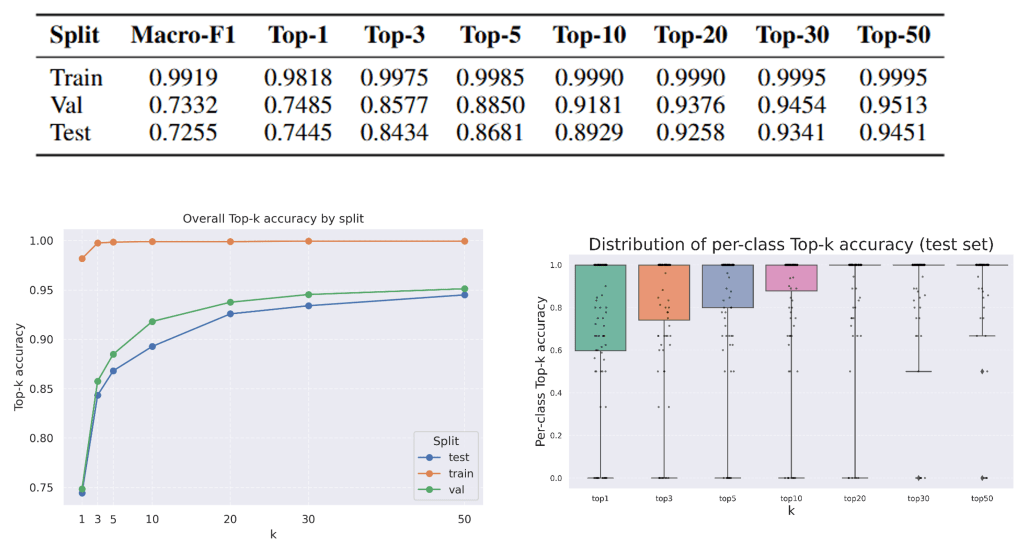
[Aneesh] It was relatively easy to incorporate BirdAVES. The repository, the instructions therein, and the example collab notebook were a very good starting point. We could easily take inspiration from it to fit BirdAVES to our needs. For instance, it was straightforward to modify the model architecture to turn it into a multi-class classifier, so that we could train it on our dataset of 173 unique individuals.
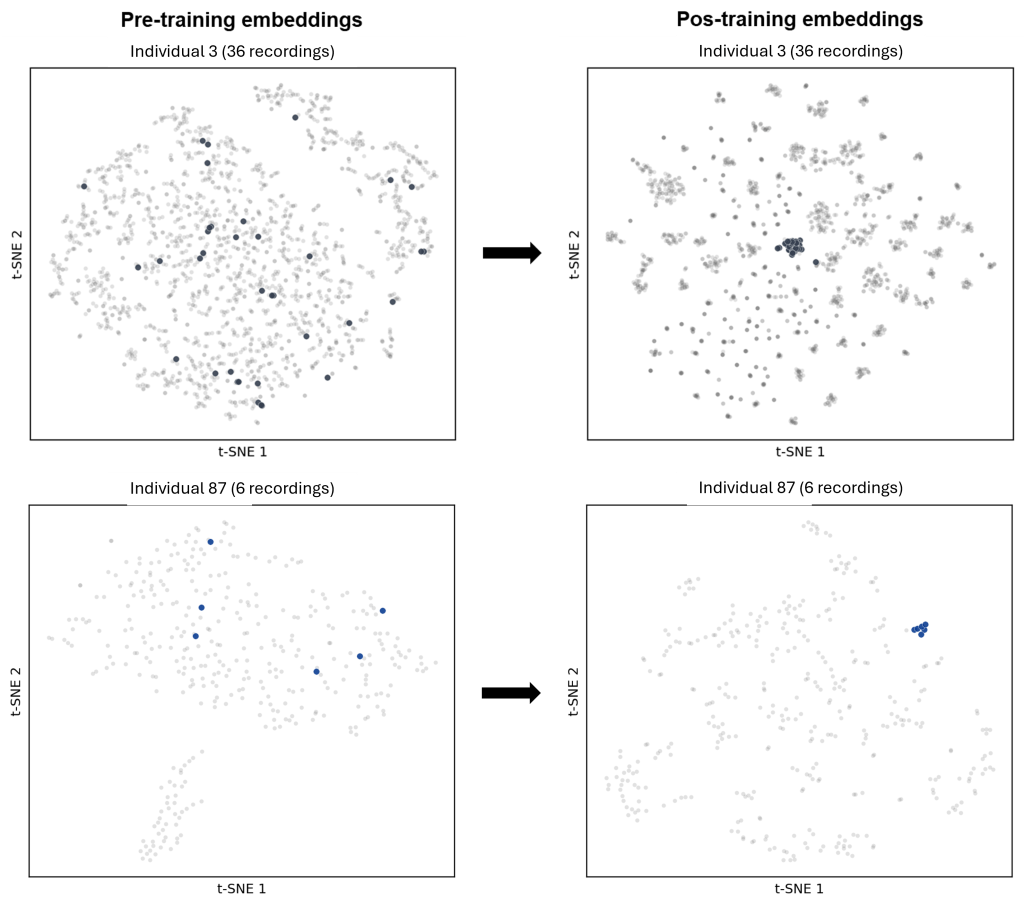
[Hugo] Being able to recognize individual birds from field data is an extremely time-consuming process to do by hand. Therefore, it does not scale. With the help of ML we could scale this up to get datasets that would allow us to answer a bunch of new questions.
How many and which individuals roughly are there in our population? Does this change over time in a predictable way with droughts and grass availability? Zebra finches are supposedly nomadic. They are strict vegetarians and only eat grass seeds. So, when do zebra finches decide to leave their known environment? Recognizing individuals (semi-)automatically would allow us to get a sense of how nomadic zebra finches are.
⮕ What are the key implications of being able to recognize individual birds from field data?
We know that zebra finch song resembles their physical as well as their breeding condition and we suspect that other individuals can use this socially available information to make their own foraging and breeding decisions. But can and do zebra finches really share information through communication networks? With the ability to recognize individuals, we could test this experimentally. We could simulate a foraging patch (provide grass seeds in a feeder) and record who is singing there. By also recording zebra finches at their stable gathering sites, we could see if individuals that heard these knowledgeable individuals are also more likely to show up at the new foraging patch.
⮕ How do you think closer collaboration between ecologists and AI/ML researchers could push this kind of work further?
[Hugo] It is very valuable to work closely with each other. Working with an AI/ML researcher, in this case Aneesh, allows me to focus on my domain-specific questions while leveraging AI/ML insights to collect a size of dataset much beyond what I could have achieved on my own. More data leads to more certainty on conclusions drawn, and it also allows the exploration of avenues of research that seemed completely out of reach. On top of these benefits, it is also very stimulating to think of problems from a very different angle.
“A blind application of technology to domain specific problems can lead to weak and in extreme cases, dangerous assumptions.”
[Aneesh] The close collaboration between ecologists and AI/ML researchers is absolutely pertinent. Without the domain-specific knowledge, an AI/ML researcher would not even know what problem needs solving, or where to start. A blind application of technology to domain specific problems can lead to weak and, in extreme cases, dangerous assumptions. Collaboration can help target the key research questions where AI/ML methods might be the most appropriate.
As a concrete example, in our work we focus on male zebra finches songs, but why? A behavioural ecologist, in our case Hugo, can immediately point out that only males sing and songs are individually distinctive. Without this context, it would be impossible to have a basis on why a dataset of male zebra finch songs can be used to train an AI/ML algorithm and have any basis for success in identifying the individuals.
Broadly, domain knowledge helps build the basis of the understanding of organisms. A blind application of AI/ML methods, at times can be like shooting with your eyes closed. An interdisciplinary collaboration, can not only help target the right problems, but also help grow the two fields of research concurrently.
Chauhan A, Loning H, ter Avest E, Botta B. BirdAVES in the wild: individual recognition as a step toward zebra finch communication networks. bioRxiv. 2025 Nov 20:2025–11. doi: https://doi.org/10.1101/2025.11.20.689459
This research was primarily funded by the Ministry of Agriculture, Fisheries, Food Security and Nature (LVVN) in the Netherlands via the Knowledge Base programme Technological Innovations for Ecosystem Monitoring, grant nr. KB-52-000-005

Aneesh Chauhan received an MSc. in Autonomous Systems from the University of Exeter, UK, in 2004 and a PhD in Informatics and Robotics from the University of Aveiro, Portugal, in 2014. After a postdoctoral position at the Aerial Robotics Lab, Technical University of Madrid (UPM), Spain, followed by a couple of years in industry at ASML in the Netherlands, he joined Wageningen University & Research in 2017, where he is currently a Senior AI and Robotics researcher. With over 20 years of experience in AI, computer vision, and robotics, his work focuses on applying deep learning, multimodal sensing, and bioacoustic approaches to challenges in agriculture, food systems, and ecology.

Hugo Loning is a researcher at the Behavioural Ecology Group at Wageningen University. His work addresses how and why animals use sounds to communicate and how they perceive their environment. Hugo’s main expertise is in songbirds, and since his PhD Hugo has worked on wild zebra finches, the model songbird system in labs worldwide, which is hardly studied in its natural environment. Hugo completed his Bachelor in Biology at the Universiteit Leiden in 2014 with a thesis on anthropogenic noise effects on blackbird song.
Hugo completed his Master Biology at Wageningen University where he conducting research on artificial light colour effects on bat roosting ecology at the Netherlands Institute of Ecology (NIOO-KNAW) and performing a comparative study on acoustic adaptation in neotropical frog species in Panama in collaboration with the Vrije Universiteit Amsterdam and the Smithsonian Tropical Research Institute. After obtaining his Master degree in Biology in 2018, he continued as PhD at the Behavioural Ecology Group at Wageningen University in collaboration with Macquarie University in Sydney. For his PhD he studied vocal communication in wild zebra finches. Hugo completed his PhD in 2023 and is now working as a researcher at Wageningen University.